All Tahoma View Stories


Find out what's happening.

Jan 30

Pilot Biochar Program Creates Fertilizer From Flame

Posted to Conservation Corner by Gracie DeMeo

by Jack Hulgan

For years, Western Washington has been experiencing an increase in wildfire severity. While climate change is one of the leading causes for this uptick, policies suppressing fire from being utilized as a way to manage fuel availability in the form of dry brush and neglected green spaces near large-scale housing developments follow close behind. For thousands of years, Indigenous peoples have been able to work in tandem with fire in a way that both decreases fuel availability and increases soil fertility. In an effort to learn from those that have stewarded the land since time immemorial while also abiding by current local codes and regulations, James Moore, Pierce Conservation District’s Climate Resiliency Program Manager, has created a Biochar Kiln Rental Program. The program gives property owners a safe way to reduce available wildfire fuel and increase their soil’s fertility. 

Hulgan_Biochar Demo_Ashford.12.06.2025

Three volunteers tending to the fire during a kiln demonstration in Ashford.

Biochar is a carbon-rich substance created from burning organic material in an environment in which oxygen is absent. This thermochemical process, called pyrolysis, requires a low-oxygen setting in order to lock in the carbon in the charcoal, rather than release it as carbon dioxide. Biochar makes an excellent soil amendment as it returns sequestered carbon back into the soil. Biochar can also change the pH of the soil depending on the ash content, but it is quite hard to exactly control this variable. Organic material burned, environmental conditions, and the temperature/duration of the burn are a few ways that can alter the pH of the biochar. Slash burns commonly used by farm and forest managers do not have the constant high heat and low oxygen for pyrolysis to occur, and most low-temperature fires have greater negative air quality effects. This is where a kiln is needed. A biochar kiln comes in many configurations and sizes, and they all accomplish the goal of maximizing heat while minimizing oxygen. Pierce Conservation District’s kiln was designed to be both easily transportable and simple to set up with 1-2 people.

A biochar kiln being filled with sticks and other organic materials.

Biochar can be made from all kinds of organic materials- even some invasive plant species like Scotch Broom.

The kiln is constructed from a series of metal sheets, brackets, and bolts. When assembled, a large cylinder is formed, and it must be packed tightly with organic material. Any gaps at the bottom of the kiln must be covered with soil to prevent the entrance of oxygen. Some property owners have stockpiled invasive species they’ve removed, or they are looking to get rid of irregular pieces of wood. An upside to utilizing a biochar kiln is the flexibility in meeting a property owner’s needs. The important thing to keep in mind is that the organic material must be dry and initially packed in tightly to keep the ignition temperature high. After the top is ignited, then you can continually feed the kiln until it’s full of charcoal and can finally be quenched. Before renting the kiln, ensure all of the items on the “Biochar Kiln Safety Checklist” located on the rental program’s page are checked off, a burn permit has been obtained, and at least one kiln demonstration or equivalent has been attended.

The four stages of assembling a biochar kiln.

Assembling the biochar kiln. 

If you want to rent Pierce Conservation District's biochar kiln, visit Biochar Kiln Rental Program | Pierce Conservation District, WA

Dec 30

Spawning Grounds Lead to Student Stewardship

Posted to Environmental Education by Gracie DeMeo

by Jack Hulgan

This fall marked the beginning of a salmon life cycle adventure for third grades in the White River School District. In the first phase of the program, students explored South Prairie Creek Preserve, where they saw pink salmon digging redds creating a safe place for their offspring to develop. Thanks to the biennial life cycle of pink salmon, 2025 was a great year to see the pinks swimming upstream to lay their eggs. Students observed the habitat surrounding the creek and pondered how these areas shape the beginning and end of the salmon life cycle. Slow currents, fallen trees, shade, gravel perfect for digging, and cool, oxygenated water were a few of the conditions the students noticed were important to a salmon looking for a spot to dig a redd.

About a dozen students and three adults looking down into South Prairie Creek.

Students observing salmon swimming upstream.

Once observations were complete students got their hands dirty maintaining healthy salmon habitat through tree-planting. Third graders planted native shrubs and trees, empowering them to improve the habitat of these indicator species. Years from now, students can reflect on their adventure at the preserve, knowing their stewardship is helping generations of salmon that arose from ones observed at the creek.

Two young girls planting a native plant together.

Students installing native plant species near South Prairie Creek.

The second phase of the experiential program started in winter. Coho salmon eggs from Voights Hatchery were delivered to four elementary schools in the White River School District, where over 300 students will care for these eggs in freshwater tanks. Students will experience three stages in the salmon’s life cycle as eggs hatch into alevin and transform into fry. In spring, third grades will release their fry into their local salmon-bearing streams and learn more about habitat, reinforcing a theme of empowerment through stewardship.

An outstretched palm that is wet holding a handful of salmon eggs above a bin of eggs.

Coho salmon eggs before they were sent to White River School District schools.

Outside of White River School District, Pierce Conservation District is partnering with the Foss Waterway Seaport and Tacoma Public School District for the annual Tacoma Salmon in the Schools program. This project (separate from the program at White River) reaches 28 schools and an estimated 1,800 students. Students will raise chum salmon eggs beginning in January, and like White River School District, they will release the salmon once they reach the fry phase.


Students looking at macroinvertebrates in a white bin.

Students hunt for macroinvertebrates collected from the creek as part of their spring outdoor experience.

Programs like these are integral, teaching students the positive effect they can have on their environment and future. Salmon are such an important resource to the people of the Pacific Northwest, and they are an excellent indicator species for the hard work salmon stewards like these students put into restoring habitats around them.

Students releasing salmon on the left bank of a creek.

Goodbye fry, and good luck on your way to the ocean!

Pierce Conservation District would like to extend a huge thank-you to our environmental educator volunteers, school staff, and partners for another great year of education and stewardship. Programs like these are only made possible with the people dedicated to keeping the next generation passionate about conservation efforts. 

Learn more about becoming an education volunteer through Pierce Conservation District’s Environmental Educator Volunteer Program.

Education Volunteer Program | Pierce Conservation District, WA

 Recently hatched alevins swimming amongst sediment.

Alevin that recently hatched at Pierce Conservation District’s office tank. 


Sep 03

A Shore Friendly Success Story: 750 feet of shoreline armor removed from Henderson Bay

Posted to Habitat Improvement by Gracie DeMeo

by Mary Krauszer, Heather GreenBefore and After pictures of Henderson Bay
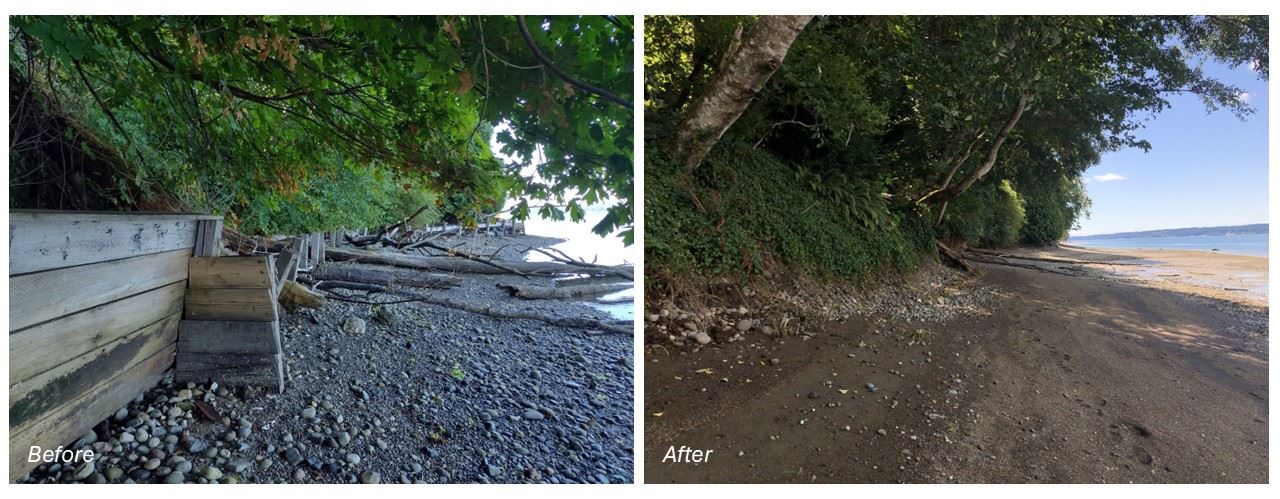
The natural shoreline and beach after a wall removal.


It is time to celebrate the removal of 750 feet of shoreline armor from the shore of Puget Sound! Pierce Conservation District (PCD) completed the Henderson Bay Shoreline Restoration project in August 2025, the culmination of years of planning and partnership through the Shore Friendly program. This project restored a natural shoreline to benefit forage fish, salmonids, eel grass, and the broader nearshore ecosystem in Puget Sound. 

According to a 2019 report by the Puget Sound Partnership, over 29% of the Puget Sound shoreline is armored, disrupting processes that build and maintain beaches and threatening the health of the nearshore. The nearshore provides vital spawning and foraging habitat for forage fish. These forage fish play a key role in the marine food web by feeding salmonids, including threatened Puget Sound Chinook. In turn, these salmon are a crucial food source for the endangered Southern Resident orcas. 

Recognizing that reduction of armor on the Puget Sound is a regional priority, many agencies have implemented projects to remove armor and restore shorelines, particularly on public properties. However, most of the shoreline of Puget Sound is privately owned. Over 1,400 miles of shoreline (or 57%) is in residential ownership. As such, private landowners must be part of the conversation on restoring shorelines of the Puget Sound. Understanding this, the Washington Department of Fish and Wildlife and others initiated the Shore Friendly program to engage waterfront residents in shoreline recovery. Through technical assistance and outreach, Shore Friendly assists residents in managing their shorelines in a natural state or restoring them to a more natural condition. 
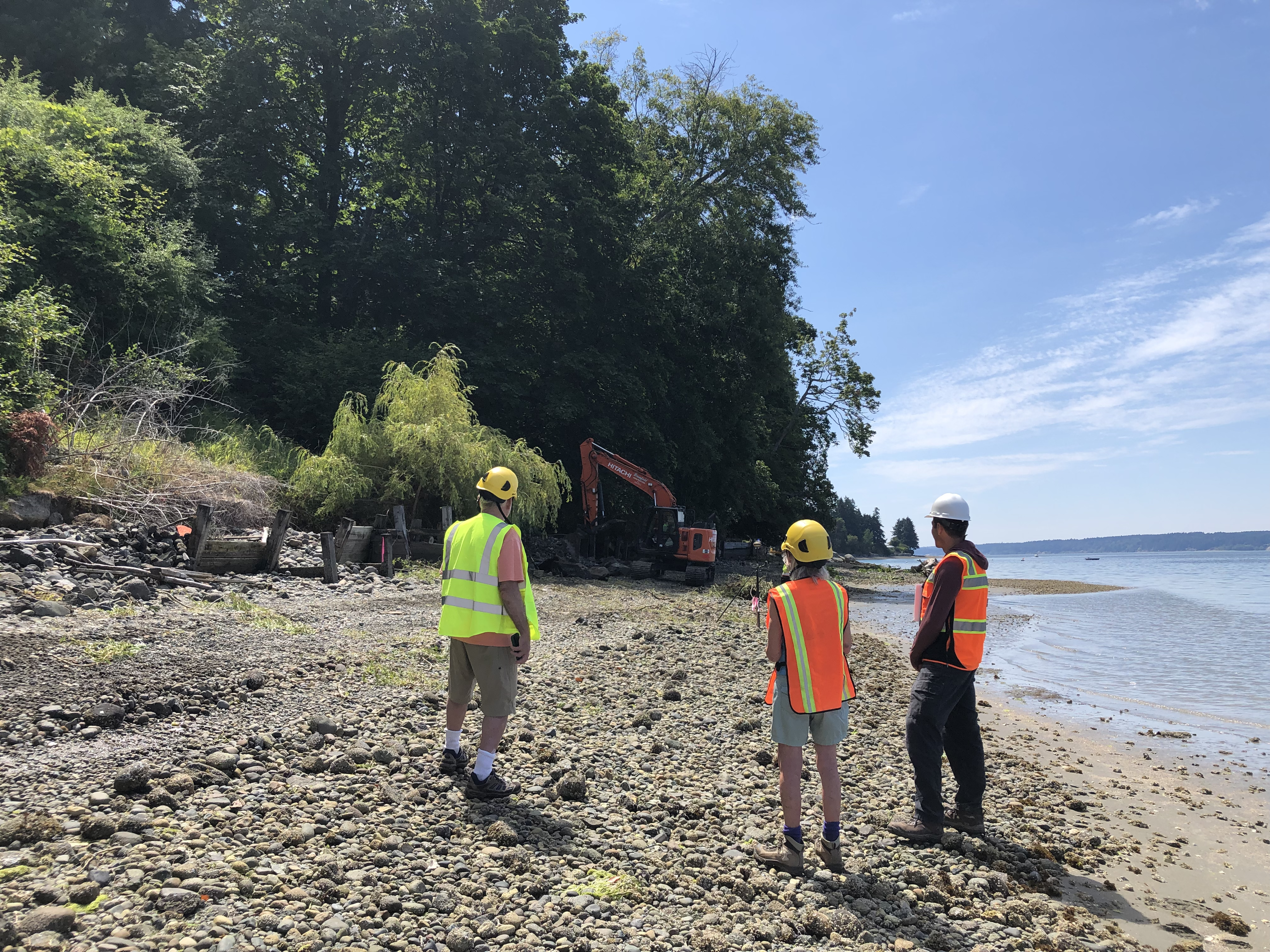
Three people in safety vests stand on the beach watching the excavators in the background working on

Excavators hard at work at Henderson Bay.

The Henderson Bay Shoreline Restoration project site is a large residential property that is unique for its size and its history of family ownership. The property was “homesteaded” in the late 19th century by a German immigrant and then sold in the early part of the 20th to the Boyles family, who still own it today. The nearly twelve acres of forestland and three acres of tidelands were protected by a conservation easement initiated by Vella Boyles, and completed by her children, Pam and James Boyles, in 2003. The current landowners, Pam Boyles and Rocky Johnson, are active supporters of Great Peninsula Conservancy (GPC), who holds the conservation easement. Shortly after the Shore Friendly Pierce program was initiated at PCD, staff at GPC referred Pam and Rocky to the program. They received technical assistance site visits under Shore Friendly before enthusiastically agreeing to partner with PCD on the shoreline restoration project. 


The opportunity to work directly with private landowners to remove shoreline armor and restore such a large stretch of shoreline – over 750 linear feet – is a rare one. The existing conservation easement on this property will prevent further development at the project site. The landowners are committed to allowing the complete reconnection of the nearshore forest, including falling trees and erosion of the bank without intervention. As sea levels rise, the shoreline on this property will be allowed to migrate landward and continue to provide upper beach habitat with marine riparian shade for use by forage fish as nearby armored beaches may be lost to coastal squeeze. 

The project is receiving a mix of local, state, and federal funding. We are using non-traditional sources, such as our local Flood Control Zone District, to bridge funding gaps between more conventional grants. PCD accessed fee-based programs such as the WA DOE Oil Spills Grant Program, which directs funds collected from oil spill penalties to restoration. We also received more conventional habitat improvement funding through the Coastal Watersheds Grant Program, under which our project qualifies as enhancing eelgrass habitat, and through the Pacific Marine Fish Habitat Partnership in recognition of the project’s benefits to fish habitat. From floods, to eelgrass, to fish, funding priorities intersect to move this nearshore restoration forward. 
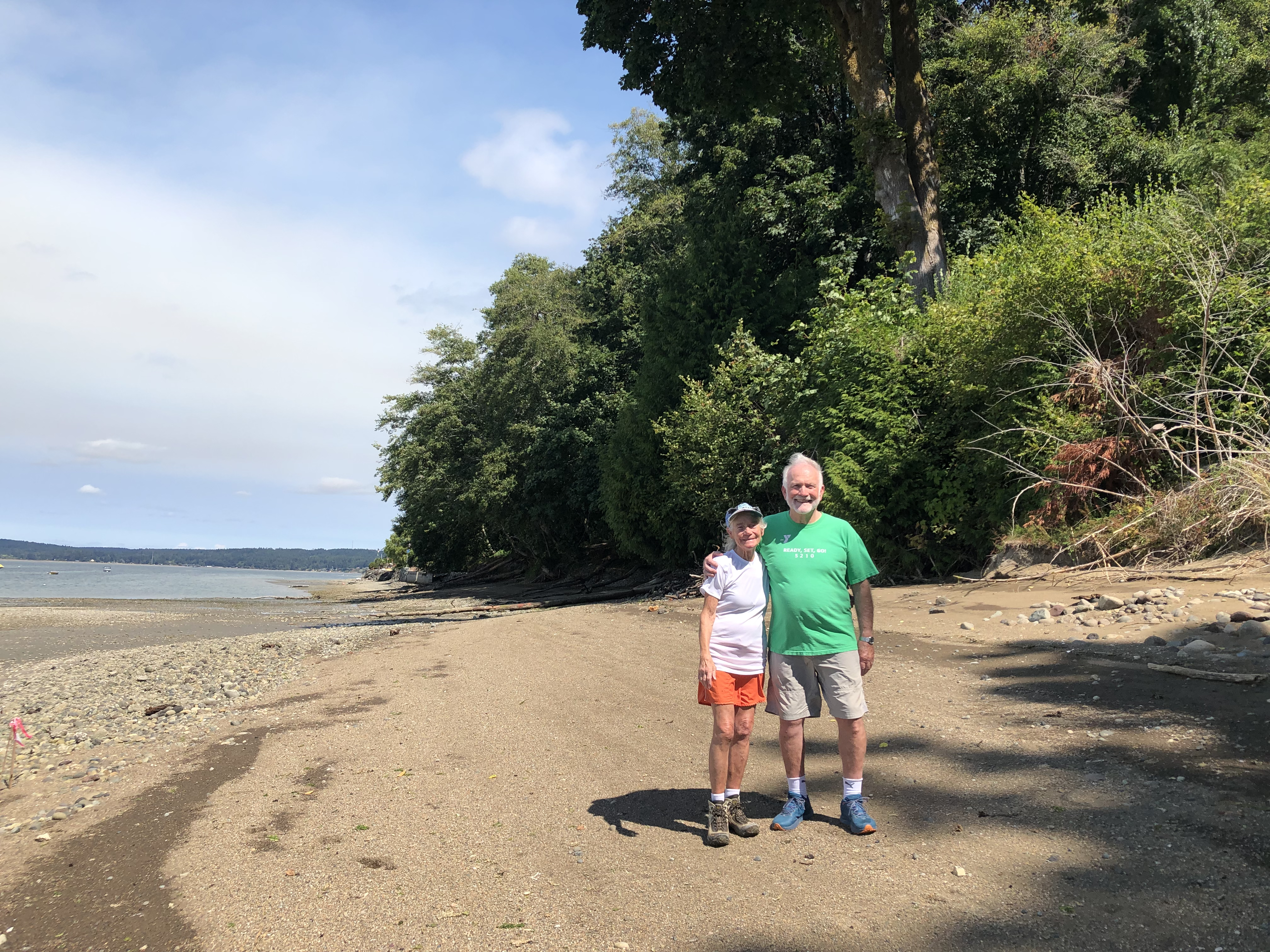
Landowners, Pam Boyles and Roger Johnson, standing on their restored beach.

Landowners, Pam B. and Roger J., proudly showing off their restored beach. 

Now that removal of the armor is complete, PCD will continue working with the landowners to further restore and enhance the marine riparian zone at the property by removing invasive plants and installing appropriate shoreline forest vegetation. This restored riparian zone will provide shade, water filtration, and organic inputs to the beach that are critical for fish like smelt and salmonids in the nearshore.

This project is a tells the story of engaging private landowners in restoration through social marketing, capitalizing on partnerships, and leveraging strategic funding to restore high-priority nearshore fish habitat through process-based restoration. 

"This project has been funded wholly or in part by the United States Environmental Protection Agency under cooperative agreement 83967501 to Restore America’s Estuaries. The contents of this document do not necessarily reflect the views and policies of the Environmental Protection Agency, nor does the EPA endorse trade names or recommend the use of commercial products mentioned in this document. For more information, please see https://estuaries.org/initiatives/watershedgrants/.”